
On this page
Your needs, this model
Does it fit your priorities?
Do you need separate floor-pad and detail setups in one wheeled canister system?
Yes. The exact 220CC kit has a floor nozzle/pad plus a gun, jet nozzle, brushes and glass attachment; tools are changed between jobs, not used together in one pass.
Explore this need in the finder →Does a 1.5 L boiler meet a 50-ounce minimum?
Yes, Reliable lists 1.5 L, about 50.7 U.S. fluid ounces. It does not meet a 51-ounce minimum, and this is a closed boiler that must cool before topping up.
Explore this need in the finder →Does the listed 20-foot power cord meet your minimum reach?
Yes, the exact model specifications list a 20-foot cord; a 21-foot minimum is not documented.
Explore this need in the finder →Do you want steam output adjustment without requiring a grip-mounted dial?
The exact 220CC page and manual describe steam-volume adjustment at the canister control panel. Discrete levels are not stated, and control is not documented on the handle.
Explore this need in the finder →Does the listed six-foot steam hose meet your minimum hose reach?
Yes, Reliable specifies a six-foot hose; a seven-foot minimum is not met.
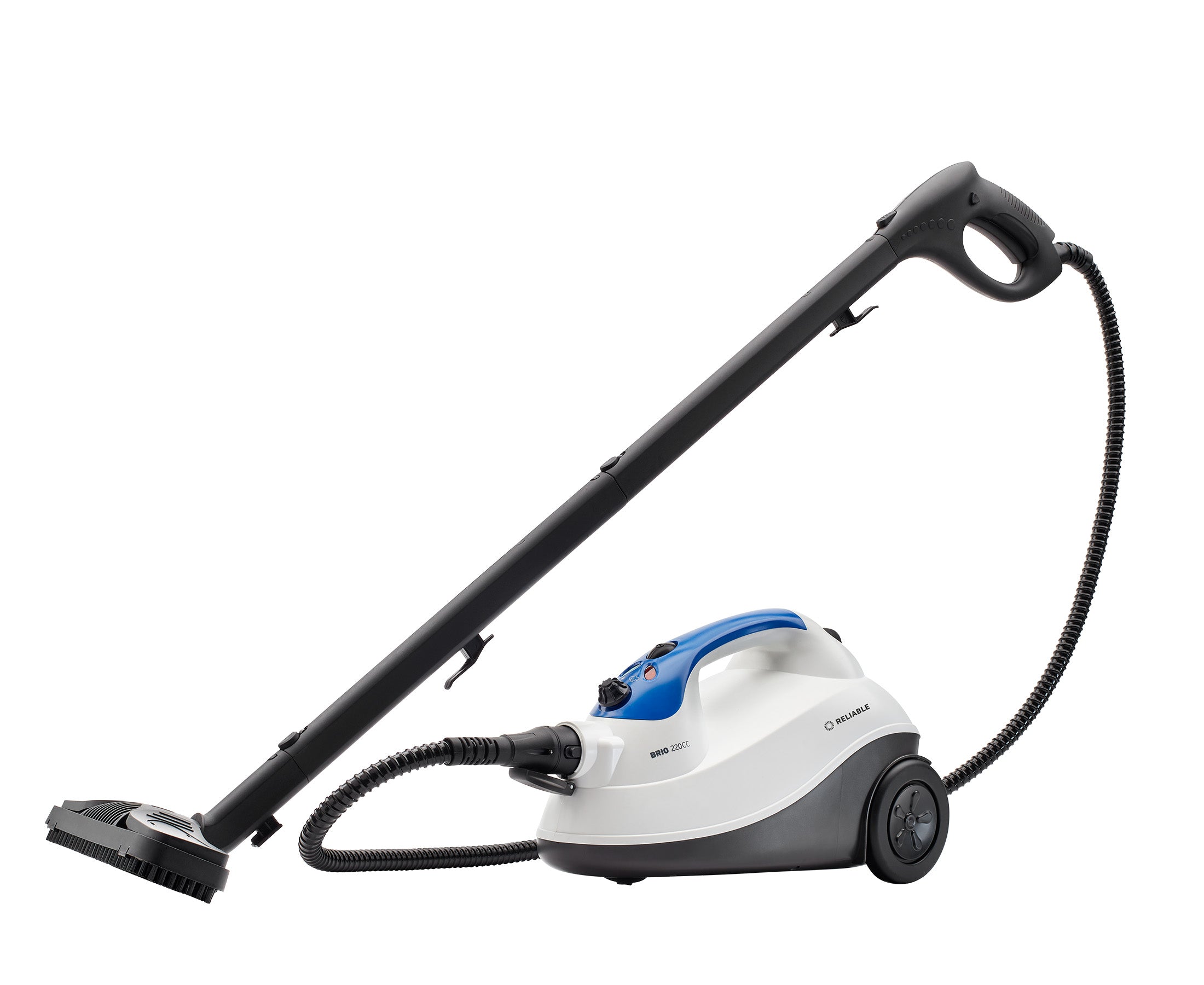
Explore this need in the finder →The Reliable Brio 220CC is a corded canister steam cleaner for a home that wants one boiler to serve a floor-pad pass and separate small-tool jobs. Its published U.S. specifications list a 1.5 L stainless-steel boiler, 4.5 bar (65 psi) pressure, a 20-foot power cord and a six-foot steam hose. The point is the mix of supplied attachments, not a claim that it vacuums or washes up liquid.
A canister that changes jobs with its tools
The 220CC is different from a steam mop whose body and floor head form one upright unit. The wheeled canister stays on the floor; a hose and steam gun take different attachments. Reliable lists a floor brush and microfiber floor pad for a separate hard-floor setup, plus a jet nozzle, extension tubes, nylon and brass detail brushes, and a window attachment with a cotton cover and squeegee. This gives one machine both a broad floor arrangement and localized detail work, but changing tools is part of using it. Anyone who mainly wants to push a lightweight mop across a kitchen will likely prefer an upright.
The 17-piece kit is useful only if the tools fit the surfaces you actually clean. The jet nozzle and small brushes are for localized work, while the glass blade is a different setup. Brass bristles are not universally safe; use them only on materials whose maker allows that brush. The manual says the floor nozzle is intended for washable wall and hard-floor surfaces, and recommends a cloth to protect more sensitive flooring. The current manufacturer page names sealed wood, tile, windows and counters as examples, not blanket permission to steam every finish. The English manual explicitly limits the appliance to household use, not commercial or industrial duty.
Capacity and controls need context
At 1.5 liters (about 50.7 U.S. fluid ounces), the listed boiler is much larger than a little handheld tank. It may suit a longer sequence of rooms or several different detail jobs before a refill, though the product’s runtime claims are not one clean test result. Reliable’s exact page says more than 35 minutes; its FAQ says up to 50 minutes on low steam and 32 minutes on high; the manual says a full tank lasts a maximum of 50 minutes. Treat those as manufacturer claims at differing settings, not a guaranteed working interval.
The manufacturer describes a steam-volume dial and the manual shows the controller on the canister. It allows flow adjustment, but the sources do not define a count of discrete levels or a handle-mounted control. That distinction matters if you need to adjust steam while holding the gun or need a documented low/high setting. The manual describes readiness after about eight minutes; the page rounds that to under ten. Its 245°F steam-tip figure is not a safe-use temperature for every floor, fabric or window. For glass, the manual instructs gradual preheating to reduce thermal-shock risk.
Refilling is a deliberate pause
The 220CC is a closed boiler rather than a separate refill reservoir that stays isolated from the hot pressure chamber. The manual says to turn the appliance off, release remaining steam, unplug it and let it cool before opening the cap; it warns that hot steam can escape. So a requirement to top up without a cooling pause is a mismatch. Plan the room around the 1.5 L fill, keep the hose and 20-foot power lead clear of walkways, and follow the manual rather than treating “continuous steam” advertising as permission to open a pressurized boiler.
There is also a water-guidance conflict worth checking. The current 220CC FAQ says to use regular tap water and not 100% distilled water. The exact manual says use water without additives and advises distilled water where tap water is very hard. Tap use is supported; the precise advice for all-distilled use is not reconciled, so ask Reliable if that is essential. Neither source permits adding detergent or fragrance. The manual also recommends emptying and drying the tank after use and periodic scale care for hard-water areas.
Who should choose another format?
Choose the 220CC when both floor and detail tools matter, a canister format suits your storage and handling, and the seller can supply the exact 17-piece kit. Do not select it for carpet refreshing: the listed package does not include a carpet glide. It also has no powered brushroll, dry-debris pickup or liquid recovery, so it is not a substitute for a wet-floor washer or vacuum. If you only need a small detail tool, the Pronto 200CS is a different handheld package; its U.S. input rating remains unresolved, so it should not be treated as an interchangeable purchase recommendation. Reliable’s 300CU is an upright floor-first model, while its 350CS converts between mop and handheld detail setups and documents low/high control at the handle. The 220CC instead offers a larger canister boiler and a different attachment kit.
Check the box and current availability
The exact U.S. offer page currently lists the 220CC by model name and marks it unavailable/backordered; no delivery date is stated. The FAQ says the 220CC comes with a storage bag and distinguishes the 225CC hard-case version, while the 220CC manual’s parts diagram calls the storage accessory a case. This does not change the canister’s basic identity, but it is a reason to verify the selling package rather than assume the 225CC case is included. Reliable lists a one-year product warranty and a separate lifetime warranty for the boiler tank. For a buyer who needs a canister’s floor-and-detail range, the Brio 220CC is a plausible fit once stock, box contents and surface compatibility are checked; it is the wrong answer for a compact mop, an instant refill or an exact hard-case requirement.
Key details at a glance
| Machine arrangement | Wheeled boiler canister and hose |
|---|---|
| Nominal water capacity | 50.7 US fl oz |
| Documented hose length | 6 ft |
| Documented power-cord length | 20 ft |
| Separate variable-flow control | Yes |
| Flow-adjustment location | Control panel |
More specifications and setup details
| Pressure gauge | No |
|---|---|
| Lockable steam output | Yes |
| Refilling during use | No |
| Controls and operation | Exact manual p. 14 describes a steam controller that turns to regulate flow; the page calls it a steam-volume dial. It is on the canister control panel; a discrete number of settings is not stated. |
| Supplied tools and setups | Current U.S. FAQ lists the 17-piece kit: extension hoses, nylon and brass brushes, window squeegee/cotton cover, adapter, floor brush/pad, handle lock, angled nozzle, funnel, measuring jug and storage bag. Manual p. 7 depicts a storage case; current FAQ says 220CC comes with a storage bag while 225CC comes with a hard case. Confirm seller box contents; do not treat the 225CC case as a 220CC feature. |
| Water and care | Manual pp. 10–12 advises testing an inconspicuous area, warns about heat-sensitive glass/plastics/wood and some fabrics, requires water only with no cleaning additives, and says to unplug before filling. Manual pp. 4, 15 says to shut off, release pressure, cool, then remove cap to refill. Follow surface makers and test first. Manual p. 6 describes the appliance as household-use-only; it is not for commercial or industrial duty. |
| Exact configuration notes | At the captured exact U.S. offer page, the 220CC was marked unavailable/backordered; no ship date is established. Check current seller availability and the exact box before purchase. |
| Manufacturer unit weight (not verified filled carry weight) | 13.7 lb |
| Carpet glider listed in the exact model kit | No |
| Documented dry-debris pickup | No |
Use the exact model’s instructions for operating limits, supplied equipment and version differences.
Sources for this assessment
- Reliable U.S. home steam-cleaners collection (reused six-card capture)
- Reliable exact U.S. 220CC retail listing
- Reliable exact 220CC specifications
- Reliable exact 220CC FAQ
- Reliable canister-steam-cleaner support page
- Reliable exact 220CC multilingual instruction manual linked by manufacturer support page
- Exact 220CC image embedded in the U.S. offer page

Choose a steam cleaner for the actual job.
Match the supplied attachment and practical filling routine to your requirements.